
AI Competencies for Assessment:
Preparing Students for Deeper Learning
Christopher DeLuca & Michelle Dubek
Educators today must be increasingly mindful of how students use AI in their learning. With the right prompts, AI can generate full assignments ready for submission. While these tools can make information gathering more efficient, what students do after information is generated is critical for meaningful learning.
The AI Competencies framework, which we first presented in Principal Connects (DeLuca & Dubek, 2025), helps educators design lessons and assessments that both leverage AI’s potential and safeguard the human dimensions of learning. Developing these competencies enables students not only to access information efficiently, but also to apply it accurately, creatively, and ethically.
By explicitly teaching and providing opportunities to practice these competencies, educators can prepare students for success in school and beyond. Today’s learners need to critically approach AI with evaluation and critical thinking skills, and the ability to extend learning beyond AI generated outputs.
The seven competencies are grouped by the three levels of the ICE model (Fostaty Young & Wilson, 1995), which organizes learning from lower-order to higher-order thinking. Similarly, AI competencies progress from concrete skills to more abstract applications, ensuring that students develop the capacity to use AI critically, constructively, and responsibly.
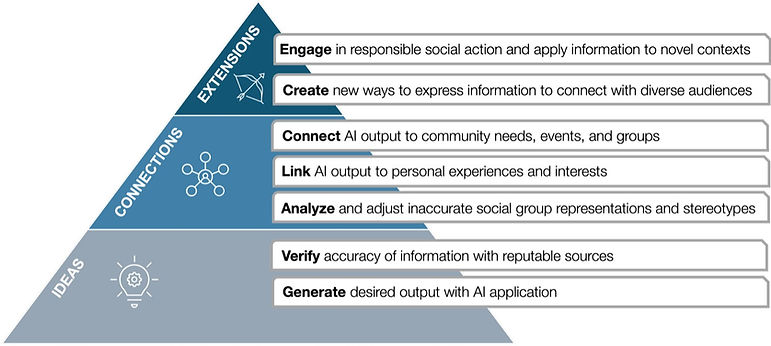
Here are some useful strategies to apply the seven AI competencies in classroom assessment design.
Competency 1: Generate desired output with an AI application
-
Design tasks where students must show both the AI prompt and the output.
-
Ask students to explain why they chose particular prompts and how they refined them.
-
Include reflection questions about challenges in generating useful output.
Competency 2: Verify accuracy of information using reputable sources
-
Require students to cross-check AI-generated information against at least two credible sources.
-
Incorporate assessment rubrics that reward source evaluation and referencing.
-
Use “fact-checking journals” where students record discrepancies and corrections.
Competency 3: Analyze and adjust for inaccurate social group representations and stereotypes
-
Include assignments that prompt students to identify bias in AI outputs.
-
Use case studies where AI produces stereotypical or exclusionary results, and ask students to critique and revise.
-
Encourage students to compare AI responses with perspectives from diverse voices and communities.
Competency 4: Link AI output to personal experiences and interests
-
Ask students to annotate AI output with personal reflections or connections to lived experience.
-
Use learning journals that combine AI insights with individual perspectives.
-
Design assessments where students must adapt AI-generated content to a project relevant to their own goals.
Competency 5: Connect AI output to community needs, events, and groups
-
Frame assignments around local or global issues, requiring students to adapt AI information to specific contexts.
-
Have students present AI authenticated work to peers, families, or community partners for feedback.
-
Create group projects where students use AI to propose solutions tailored to real-world challenges.
Competency 6: Create new ways to express information for diverse audiences
-
Assess students’ ability to transform AI output into multiple formats (e.g., infographic, podcast script, public service announcement).
-
Include criteria for audience awareness and communication style in success criteria and rubrics/evaluation tools.
-
Have students test their work with different audiences (e.g., classmates, younger students, non-experts) and refine accordingly.
Competency 7: Engage in responsible social action and apply information in novel contexts
-
Encourage students to use AI-informed and authenticated work to design solutions, campaigns, or initiatives that address authentic problems.
-
Assess students’ ability to transfer AI-supported learning into new contexts, such as interdisciplinary projects or civic engagement.
-
Incorporate ethical reflection prompts about the broader implications of using AI in decision-making and action.
Guiding Principle for Assessment Design
When designing assessments, the goal is not to restrict AI use but to enhance AI competencies in students and to make AI’s role transparent and purposeful. Build in checkpoints where students must document their process, explain decisions, and reflect on learning. This ensures that AI becomes a tool for deeper thinking rather than a shortcut for completed work.
Reference:
DeLuca, C., & Dubek, M. (2025). AI Competencies and Student Success in a Digital World. Principal Connections, 28(3), 26-28.